
Running a small embroidery shop comes with unique challenges. You may have fewer machines, a smaller team, limited production space, and a tighter budget than a large embroidery business. At the same time, customers still expect clean designs, quick turnaround, accurate stitching, and professional results. 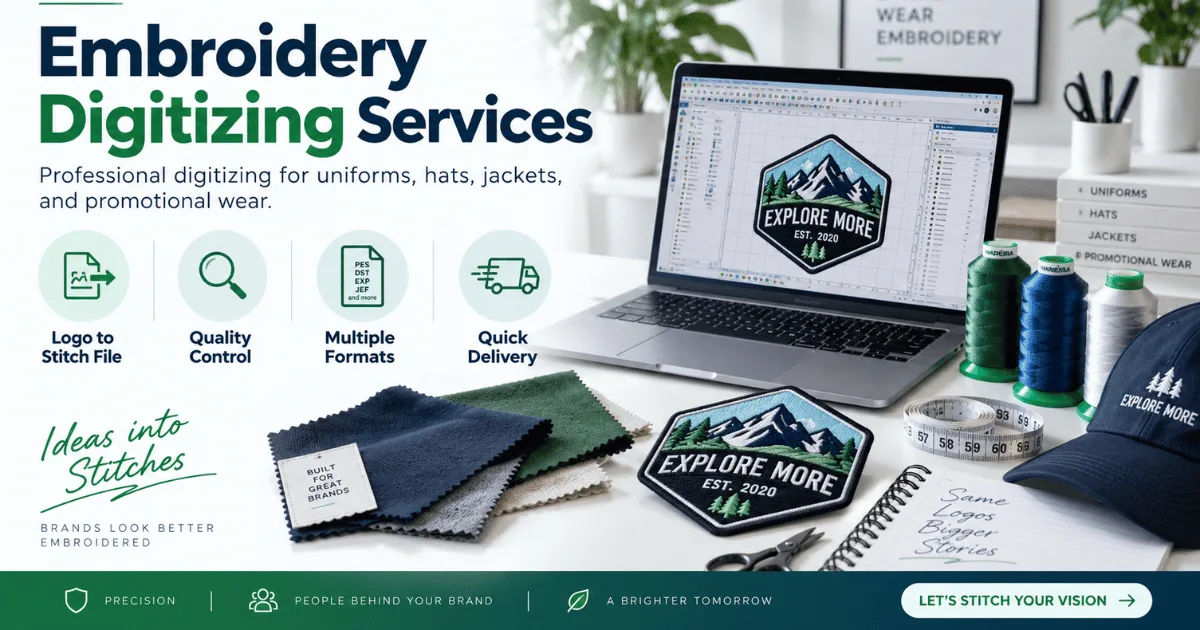
For many small businesses, outsourcing digitizing is more practical than hiring a full-time digitizer. A good embroidery digitizing company can convert logos, artwork, lettering, and other graphics into machine-readable embroidery files. This allows shop owners to focus on customer service and production while experienced professionals handle the technical preparation of designs.
The right provider should do more than simply create a file. A suitable embroidery digitizing company should understand the needs of smaller shops, including affordable pricing, flexible order quantities, reliable communication, multiple file formats, reasonable turnaround times, and revisions when necessary. The goal is to find a partner that provides professional quality without creating unnecessary costs or complicated processes.
Why Small Embroidery Shops Need Reliable Digitizing
Small embroidery shops often operate with limited resources. Every production mistake can affect profit because there may not be enough volume to absorb wasted thread, garments, or machine time.
A poorly digitized design can create several problems. It may contain excessive stitches, unnecessary jumps, poor underlay, incorrect density, or unsuitable stitch directions. These problems can lead to thread breaks, fabric damage, distorted lettering, and an unattractive finished product.
Professional digitizing helps prevent many of these issues. An experienced digitizer examines the artwork and determines how different areas should be constructed using stitches.
This becomes especially important when a shop handles different garments and materials. A design that works well on a cotton shirt may require adjustments for a cap, jacket, fleece garment, towel, or performance fabric.
Small businesses benefit when their digitizing provider understands these differences rather than treating every design exactly the same.
What Should Small Shops Look For?
Choosing a provider should not be based on price alone. Several factors can determine whether a service is genuinely useful for a small embroidery operation.
Affordable and Transparent Pricing
Budget is one of the biggest concerns for a small shop. Large embroidery businesses may place dozens or hundreds of orders every month, while a small shop may need only a few designs at a time.
This makes transparent pricing particularly valuable.
A suitable provider should explain how pricing works before beginning the project. Some designs may cost more because they contain detailed artwork, multiple colors, small lettering, or complicated elements.
Small shops should avoid providers that advertise extremely low prices but add unexpected fees later.
A reasonable price should reflect the complexity of the artwork and the skill involved in creating a production-ready file.
No Excessive Minimum Order Requirements
Large digitizing providers may be structured around high-volume customers. That can make them less convenient for small embroidery businesses.
A small shop may need one logo digitized today and another design several days later. It should not have to purchase a large package simply to access professional services.
A flexible embroidery digitizing company is often a better fit because it can accommodate individual projects as well as recurring orders.
This flexibility allows a shop to control expenses and order services according to actual customer demand.
Fast Turnaround Matters
Time is valuable in embroidery production. Customers often have deadlines for uniforms, promotional clothing, events, sports teams, company merchandise, and special occasions.
A delayed digitizing file can delay the entire order.
For this reason, small shops should look for a provider with clearly stated turnaround times. Standard jobs should be completed within a predictable timeframe, while urgent services may be available when a customer has a tight deadline.
However, speed should not come at the expense of quality.
A file delivered quickly but requiring several corrections may ultimately take more time than a carefully prepared file delivered within a reasonable schedule.
The best balance is dependable turnaround combined with consistent quality.
Support for Popular Embroidery File Formats
Different embroidery machines require different file formats. A small shop may work with one machine today and add another machine in the future.
This makes format compatibility an important consideration.
A professional provider may support formats such as DST, PES, JEF, EXP, VP3, XXX, and other machine-specific formats.
DST is widely used with commercial embroidery machines, while PES is commonly associated with Brother embroidery systems. JEF is often used with Janome machines.
The important point is that the digitizing service should provide the format needed by the shop's equipment.
Before placing an order, shop owners should confirm which formats are available and whether additional formats can be supplied when needed.
Quality Should Come Before Stitch Count
Stitch count is sometimes used as a simple way to compare embroidery services. However, the lowest stitch count does not automatically mean the best digitizing.
Reducing stitches too aggressively can make a design look weak or incomplete.
On the other hand, adding unnecessary stitches can make embroidery heavy, stiff, and expensive to produce.
A skilled digitizer looks for the right balance.
The design should contain enough stitches to create proper coverage and definition without adding unnecessary density.
Good digitizing also considers stitch direction, sequencing, underlay, pull compensation, trims, and other technical factors.
This is why small shops should evaluate the quality of finished samples rather than choosing a provider based only on advertised stitch counts.
The Importance of Sample Work
Before committing to a long-term relationship, a small embroidery business should examine examples of previous work.
A portfolio can reveal how well a provider handles different types of artwork.
Look for examples involving logos, lettering, small details, caps, jackets, patches, and other products similar to the work your shop regularly produces.
Pay attention to edges, curves, lettering clarity, color transitions, and overall stitch appearance.
If possible, evaluate actual embroidered samples rather than relying only on digital previews.
A design can look excellent on a computer screen but behave differently when stitched onto fabric.
How Communication Affects the Experience
Communication is often overlooked when selecting a digitizing service.
For small shops, however, communication can be extremely important. A shop owner may need to explain a customer's expectations, request a specific stitch effect, provide garment information, or ask for a revision.
A responsive provider makes these conversations easier.
A good embroidery digitizing company should provide a clear way to submit artwork and communicate about the project.
Email, online ordering systems, messaging platforms, or other convenient communication channels can all work well.
The key is responsiveness and clarity.
If questions remain unanswered for days, a small shop may struggle to meet its own customer deadlines.
Artwork Requirements Should Be Flexible
Not every customer will provide a perfect vector logo.
Small embroidery shops often receive artwork in JPG, PNG, PDF, screenshots, photographs, or other formats.
A capable digitizing provider should be able to evaluate different types of artwork and explain whether additional preparation is necessary.
High-quality artwork generally makes digitizing easier, but customers do not always understand technical file requirements.
The provider should guide the shop instead of simply rejecting an imperfect image.
In some cases, artwork may need cleanup or vector conversion before digitizing. Understanding this process helps shop owners communicate more effectively with their customers.
Revisions Can Save Small Shops Money
Even carefully prepared embroidery files may require adjustments.
A design may stitch differently on a particular fabric or machine than expected. Lettering may need to be enlarged, spacing may require correction, or a customer may request a minor design change.
A useful provider should have a reasonable revision policy.
This does not mean every revision should be unlimited or free. Major artwork changes may reasonably require additional work.
However, minor corrections should be handled professionally.
For small shops, a revision policy can prevent unnecessary expenses and help ensure that the final design meets the customer's expectations.
Does the Provider Understand Different Fabrics?
Fabric behavior has a major influence on embroidery.
Stretchy fabrics can move during stitching. Thick materials can require different approaches. Lightweight garments may need lighter densities, while heavy jackets may tolerate more substantial stitching.
Caps create another challenge because their curved surfaces affect how designs should be digitized.
A provider experienced with different materials is therefore valuable to small embroidery businesses.
T-Shirts
T-shirts are commonly made from relatively lightweight fabrics. Designs often need appropriate underlay and pull compensation to prevent distortion.
Caps
Caps require careful consideration because the front panel is curved. Stitch direction and sequencing can affect how the design appears after stitching.
Jackets
Jackets and heavier garments may support larger designs, but thickness and construction can influence needle penetration and stitch appearance.
Towels
Towels have textured surfaces that can hide fine details. Digitizing often needs to account for the pile of the fabric.
A provider who understands these differences can create files that perform more reliably across products.
Customer Service Is More Important for Small Shops
A large company may have dedicated staff members for ordering, production, technical support, and customer service.
Small shops often do not.
The owner may handle almost everything personally.
Because of this, customer service from an outside provider becomes especially valuable.
A helpful service can reduce the amount of time a shop owner spends solving technical problems.
Clear instructions, organized file delivery, quick responses, and professional support can make outsourcing much easier.
A small business should consider the entire customer experience rather than judging a provider only by the digitizing price.
Should Small Shops Choose Local or Online Providers?
Small shops do not necessarily need a provider located nearby.
Online digitizing services can work with businesses in different cities and countries because designs can be submitted and delivered digitally.
This provides access to a larger selection of specialists.
A local provider may offer face-to-face communication, while an online provider may provide longer operating hours, broader format support, or competitive pricing.
The better choice depends on the shop's priorities.
Location matters less when communication is reliable and digital file delivery is fast.
Security and File Management Matter
Embroidery files can contain valuable customer artwork, company logos, names, and other business information.
Small shops should therefore consider how their digitizing provider handles submitted files.
A professional service should have a sensible approach to file storage and customer privacy.
It is also helpful when completed files are organized clearly.
File names should make sense and identify the design or customer without creating confusion.
Good file management saves time when an existing design needs to be reordered months later.
Why Experience Matters
Experience can make a significant difference in embroidery digitizing.
An experienced embroidery digitizing company is more likely to recognize problems before the design reaches the machine.
For example, an experienced digitizer may notice that very small lettering will not stitch clearly at the requested size.
They may recommend enlarging the letters, changing the font, simplifying the artwork, or adjusting the stitch structure.
This type of practical advice can protect a small shop from failed samples and unhappy customers.
Experience also helps when dealing with unusual artwork.
Complex logos, gradients, fine outlines, detailed illustrations, and small text often require thoughtful decisions rather than automatic conversion.
How to Compare Several Providers
Small shops should create a simple comparison before selecting a long-term service.
Start by reviewing portfolios.
Next, compare pricing structures and turnaround times.
Then check supported file formats and revision policies.
Communication should also be tested.
A shop can send a basic inquiry and observe how quickly and professionally the provider responds.
It may also be useful to order a test design before sending regular work.
This provides a practical way to judge quality, communication, delivery, and file organization.
Common Mistakes Small Shops Should Avoid
One common mistake is choosing the cheapest service without checking quality.
Low pricing can be attractive, but poor digitizing can cost more through wasted garments and machine time.
Another mistake is assuming every provider handles every type of embroidery equally well.
Some digitizers may specialize in logos, while others may have stronger experience with caps, patches, lettering, or specialty effects.
Small shops should also avoid selecting a provider without understanding turnaround policies.
If urgent work is common, this should be discussed before regular orders begin.
Finally, shops should not overlook communication.
Even an excellent digitizer can become difficult to work with if responses are slow or instructions are unclear.
What Makes the Best Choice for a Small Shop?
The ideal provider is not necessarily the largest company.
It is the one that matches the shop's actual needs.
For most small embroidery businesses, the strongest choice will offer dependable quality, reasonable prices, flexible order sizes, multiple file formats, fast communication, reliable turnaround, and useful revisions.
A good embroidery digitizing company should also understand that small businesses need predictable costs.
Unexpected problems can have a larger impact on a small shop than on a large production facility.
The provider should therefore operate as a dependable service partner rather than simply a place to purchase individual files.
A Simple Checklist Before Hiring
Before selecting a provider, ask these questions:
Pricing
-
Is pricing clearly explained?
-
Are there additional charges for complex designs?
-
Are minor revisions included?
Quality
-
Can I see examples of completed work?
-
Does the provider handle small lettering well?
-
Can it work with detailed logos?
Compatibility
-
Are DST, PES, JEF, and other relevant formats available?
-
Can multiple machine formats be supplied?
Turnaround
-
What is the normal delivery time?
-
Is rush service available?
-
Are deadlines communicated clearly?
Customer Service
-
How can I contact the team?
-
How quickly do they normally respond?
-
Can they explain technical recommendations?
Flexibility
-
Can I order one design at a time?
-
Is there a minimum order?
-
Can the provider handle occasional larger projects?
Answering these questions can help a small shop narrow its choices quickly.
When Outsourcing Makes the Most Sense
Outsourcing is particularly useful when a shop does not have an in-house digitizer.
It can also help when the shop receives designs only occasionally and does not want to invest in expensive digitizing software.
Professional software can require significant investment, and learning to use it effectively takes time.
There is also a difference between knowing how to operate software and knowing how to create embroidery files that stitch properly.
By outsourcing, a small shop can access specialized skills without adding another full-time employee.
This can make the business more flexible and reduce overhead.
Building a Long-Term Relationship
Once a shop finds a provider that consistently delivers good work, maintaining that relationship can be beneficial.
Regular collaboration allows the digitizer to become familiar with the shop's machines, preferred settings, common garment types, and customer expectations.
Over time, this familiarity can make orders easier to process.
The shop may also spend less time explaining recurring requirements.
A reliable long-term relationship can therefore become a valuable part of the business workflow.
However, shops should continue monitoring quality. A good relationship should never replace quality control.
PSA Digitizing is a trusted and customer-friendly embroidery digitizing company that transforms artwork, logos, and graphics into professional, machine-ready embroidery files such as DST, PES, JEF, and other formats. Located in Clarkston, Georgia, USA, the team combines experienced craftsmanship with advanced digitizing technology to create clean, precise, and stitch-friendly designs at reasonable prices.
With a strong 4.5+ star rating on Trustpilot, PSA Digitizing has earned the confidence of embroidery businesses, apparel decorators, and hobbyists. From logo digitizing and custom patches to complete machine embroidery files, the focus remains on accuracy, quality, fast turnaround, and an easy customer experience. To get your artwork digitized, visit psadigitizing.com.
Conclusion
Choosing the right digitizing provider can have a major effect on the success of a small embroidery shop. The best option is not necessarily the cheapest or biggest provider. Instead, small businesses should look for a service that understands their production needs and provides consistent value.
A dependable embroidery digitizing company should combine technical skill with practical customer support. Affordable pricing, flexible order quantities, reliable turnaround, multiple file formats, revisions, and strong communication are all important factors.
Quality should remain the main priority. A well-digitized design can stitch smoothly, maintain clean details, reduce production problems, and produce a professional result for the customer's garment. A poorly prepared file can create the opposite experience, even when the original artwork is excellent.
Small shops should also consider the types of products they produce. A business specializing in caps may need different digitizing expertise from a shop that primarily decorates T-shirts or jackets. Understanding these differences can help owners choose a provider with relevant experience.
Testing a provider with a small project is one of the safest approaches. Review the finished file, stitch it on the intended material, evaluate the result, and consider how easy the overall process was. This practical experience can tell a shop much more than an advertisement.
In the long run, the right embroidery digitizing company should feel like an extension of the shop's production team. It should make the process easier, not create additional complications. When quality, communication, pricing, and reliability are balanced, outsourcing digitizing can allow small embroidery businesses to accept more orders while keeping their operations efficient.
For a small shop, the ideal provider is ultimately one that delivers professional results at a reasonable cost and understands that every order matters. By comparing services carefully and testing quality before committing to regular work, shop owners can build a dependable workflow that supports both customer satisfaction and business growth.